Replacing gas heating exclusively with heat pumps isn’t always the best way to cut carbon. Here’s what building owners need to know when selecting and designing a system.
Fossil fuels used for heating account for 20% of the US commercial building sector’s energy use, making electrification essential for companies working to meet emissions reduction targets.
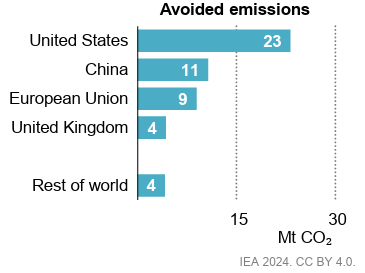
These benefits are already materializing: the IEA estimates that heat pumps
enabled CO2 savings of 23 megatons in the U.S. between 2019 and 2023, the largest reduction globally over that period. Combined with strong efficiency gains, the case for heat pumps is clear. Even so, achieving these energy and emissions savings often requires a broader, integrated approach beyond heat pump retrofits.
Here’s what building owners and operators need to know.
WHEN DO HEAT PUMPS OPERATE MOST EFFICIENTLY?
Generally, heat pumps transfer heat from a source to a sink; in other words, from where it’s not needed to where it’s needed. In cooling mode, a heat pump moves heat from an indoor space to the surrounding environment. In heating mode, the process reverses, transferring heat from the environment into an indoor space.
Moving heat from one place to another requires work, or “lift,” which is characterized by a temperature difference. Heating is a considerably more difficult task than cooling, as it requires greater lift.
As shown in the chart below for an air-source (air-to-water) heat pump, typical cooling action requires a lift of approximately 50°F. However, heating action involves a lift of roughly 90°F to 110°F, about double that of cooling.
Lift needed for heating is more than twice as much as lift required for cooling.
Source: Daikin
The greater the lift, the more work the heat pump must do. Therefore, as the desired hot water supply temperature rises relative to the temperature of the heat source, efficiency decreases. Conversely, decreasing the hot water supply temperature relative to the heat source temperature increases heat pump efficiency.
For example, heat pumps are more efficient, achieving a higher Coefficient of Performance (COP), at hot water supply temperatures of 120°F to 140°F, rather than the traditional 140°F to 180°F range used for peak heating conditions (see chart).
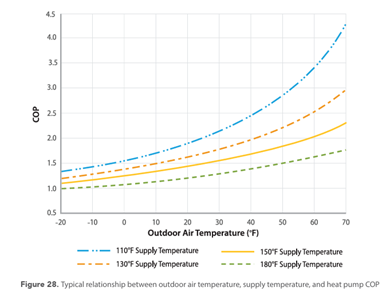
Caption: Heat pump efficiency relative to outdoor and supply temperatures.
Source: NREL
However, delivering a lower hot water supply temperature has significant implications for other building systems.
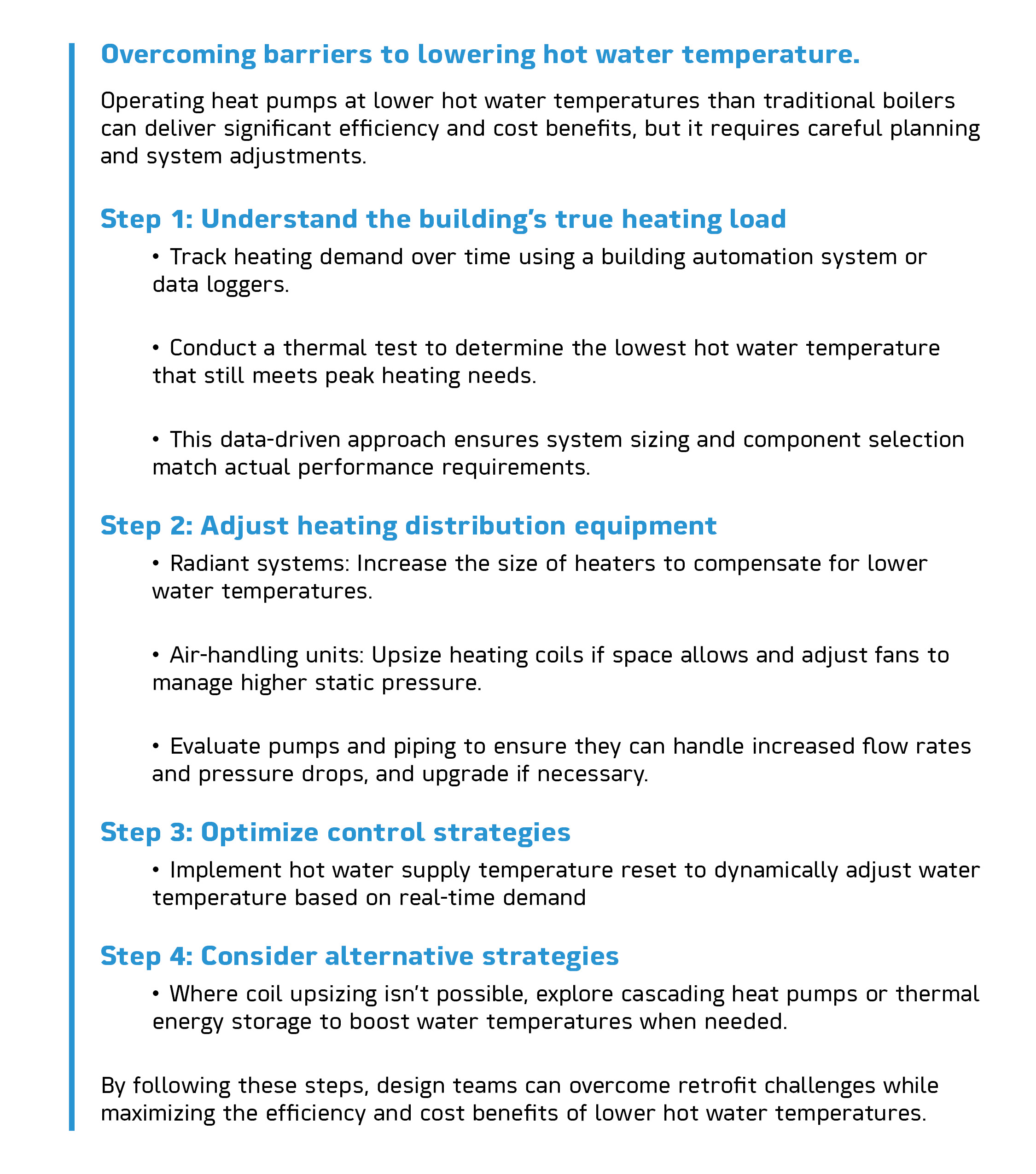
For new construction, the building can be designed to accommodate a heat pump system optimized for efficiency at a lower hot-water supply temperature. However, in retrofit scenarios, achieving lower supply temperatures may require significant changes to the incumbent HVAC infrastructure to meet building loads.
WHAT ARE THE CHALLENGES OF RETROFITTING HEAT PUMPS?
In many existing buildings, radiators and heating coils are designed to meet peak building loads at water temperatures of 140°F to 180°F. Traditionally, natural gas-fired boilers have provided these supply temperatures.
Some advanced heat pumps can achieve higher hot water temperatures, but doing so often involves trade-offs in efficiency and cost.
The options for reducing building loads to align with lower supply temperatures are also limited. While it may be possible to upgrade windows and roofs to improve insulation, aspects such as building orientation and wall construction cannot easily be changed.
Radiator and convection coils could be replaced with larger devices to increase heat transfer surface area, but this may not be possible due to space and static pressure limitations.

Caption: Radiator retrofits in action at Carleton College in Northfield, MN.
Source: Daikin Applied
Buildings served by air-handling equipment designed for high hot-water temperatures often face similar challenges when retrofitting for lower supply temperatures. These include the need to increase coil size and manage higher static pressure drops, upgrading pumps and fitting different pipe sizes to meet current building loads.
A NEW MINDSET FOR A DECARBONIZED FUTURE
To maximize energy, cost, and emissions benefits, building teams must embrace lower hot-water supply temperatures and design systems around the technology’s strengths, rather than trying to replicate fossil fueled heating systems.